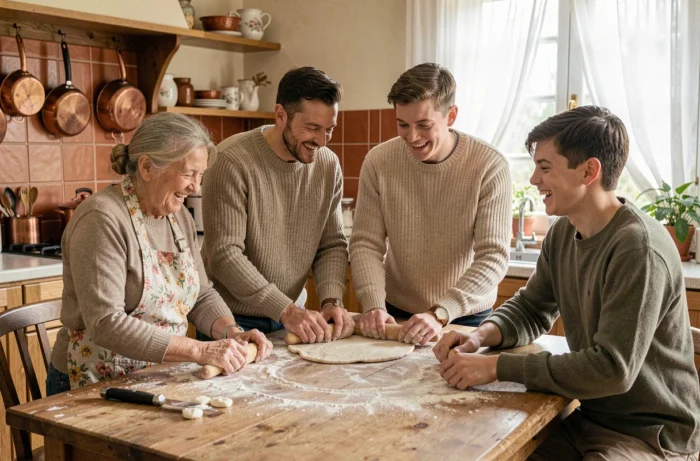
Recent surveys on family practices show a shift in how parents and children share their daily lives. The focus is no longer solely on the time spent together, but on the quality of interaction during that time. Family bonding moments are built less by accumulating activities and more by the nature of the attention given to each exchange.
Shared screens and family bonding: what recent recommendations change
Most articles on family life address screens from the perspective of limiting time. The parental recommendations published in 2025-2026 shift the focus: co-usage of screens matters more than the number of minutes. For toddlers, a cartoon watched with a parent who comments and asks questions has a different effect than a tablet left for independent use.
Health authorities now clearly distinguish between screens used alone and those shared as a family. Before 18-24 months, solitary use remains discouraged. However, a video call with a grandparent or watching a suitable program together can have real social and relational value.
This distinction provides a concrete angle for parents who feel guilty: protecting sleep, meals, and free play is more important than a rigid timer. Rather than counting screen minutes, the focus should be on ensuring that moments of human connection (conversation, physical play, reading) are not sacrificed. Several recent guides for parents recommend thinking in terms of content and context rather than raw duration.
Practically, this means that a family movie night where everyone comments, laughs, and discusses after the credits can become a true bonding ritual, provided the screen serves as a support for exchange rather than a substitute. What has been observed through recent research and field feedback complements what many parents intuitively feel: in family on Maman pas comme les Autres … ou Presque, sharing ideas around a screen or a book works precisely because they place the relationship at the center.

Family rituals: why regularity trumps originality
The temptation is strong to seek spectacular activities to create memories. Feedback from parental support programs tested in 2025-2026 indicates a different direction: simple but regular activity supports facilitate parent-child engagement.
A ritual does not need to be elaborate to work. What makes it effective is its predictability. Children find a reference point, and parents have a framework that reduces the mental load associated with organization.
- A weekly meal where everyone shares the best moment of their week, without phones on the table, establishes a conversation habit that naturally extends beyond the meal.
- A Sunday walk on the same route, observing the changes of the seasons, gives younger children a sense of continuity and mastery over their environment.
- A shared reading moment in the evening, even brief, where the adult reads aloud for all ages of the siblings, creates a calm space that encourages spontaneous confidences.
The regularity of these rituals produces a cumulative effect. It is not a single screen-free dinner that changes the family dynamic, but the repetition week after week that builds trust and complicity.
Adapting bonding moments to children’s ages
In a family with several children of different ages, finding an activity that suits everyone often feels like a puzzle. Field feedback varies on this point: some parents bet on unifying activities, while others prefer individual time with each child.
Both approaches have their place. Exclusive time with one child, even brief, disproportionately strengthens the bond compared to its duration. Half an hour of cooking with the oldest while the youngest naps, or a bike ride with the youngest while the older ones are occupied, is enough to nurture a sense of recognition in the child.
For collective activities, the principle is to choose a framework flexible enough for everyone to participate at their level. Cooking works well: the youngest mixes, the oldest cuts, the parent supervises. The shared result (a cake, a pizza) materializes cooperation.
The trap of over-organization
Planning every minute of a family weekend often produces the opposite effect of what is sought. The pressure to “succeed” in the bonding moment generates stress, especially for the organizing parent. Spontaneous interactions remain the most fertile ground for complicity.
Leaving empty slots in the family schedule allows for the emergence of these unplanned moments: a fit of laughter over an improvised board game, an unexpected conversation during a car ride, a spontaneous hug on the couch. These sequences do not appear on any advice list, yet they are often the ones children remember.
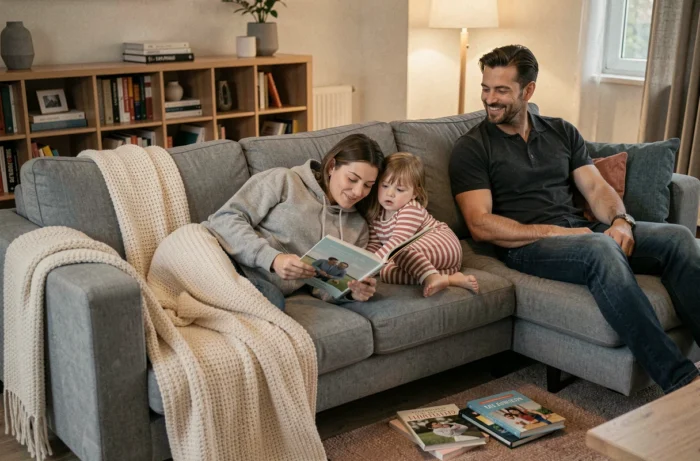
Daily life and bonding: turning chores into playtime
Family daily life (shopping, cleaning, tidying) is rarely presented as a space for bonding. However, it can become one if we accept to slow down and involve children in these tasks, not for their educational value, but for the time spent side by side.
- Shopping together by giving each child a mini-list transforms a chore into a collaborative mission.
- Folding laundry while chatting or listening to music creates a physical closeness conducive to informal exchanges.
- Gardening, even on a balcony with a few pots, gives a common project to follow over time, with visible results that strengthen the sense of teamwork.
Family complicity is built as much in daily life as in exceptional moments. A child who helps prepare dinner every evening develops a routine of closeness with their parent, stronger than a trip to an amusement park once a year.
What emerges from practices observed in recent years is that family complicity is not decreed. It is cultivated through small repeated choices: being present without a phone, listening without correcting, accepting that the perfect moment does not exist, and that the real moment is more than enough.