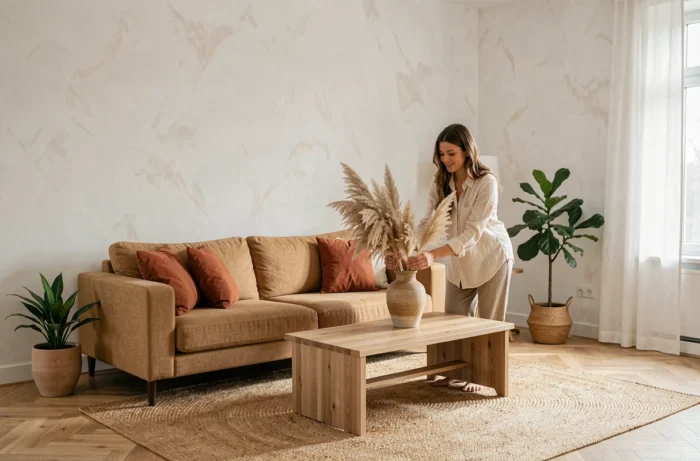
A living room wall repainted in warm sand looks nothing like the dull beige that was used in the 2000s. The difference lies in the undertone: recent formulations incorporate a hint of clay or soft yellow that warms the light instead of dulling it. This shift explains why warm sand color is now establishing itself as the base for living spaces, directly replacing the cool grays that have dominated for a decade.
Room Orientation and Choice of Sand Undertone
We always start with the light. A north-facing room receives cold, bluish lighting for a good part of the day. Applying a grayish sand in this context produces a dull result, almost dirty by late afternoon.
For a north-facing exposure, recent renovation guides recommend pink or slightly golden sands, containing a hint of yellow. These undertones compensate for the coldness of natural light and maintain a sense of warmth even on overcast days.
In contrast, in a south or west-facing room, one can afford a more neutral sand, leaning towards putty or mushroom, without risking a flat effect. Direct light is enough to reveal the depth of the pigment. When looking for decor ideas in warm sand color, this light diagnosis is the first reflex to have before choosing a reference from a manufacturer.
A simple test: apply two samples of sand (one pink, one gray) on the least lit wall of the room, observing at three different times of the day. The result varies considerably with the seasons, but this method avoids unpleasant surprises after the second coat.
Warm Sand Palette in the Living Room: Concrete Combinations That Work
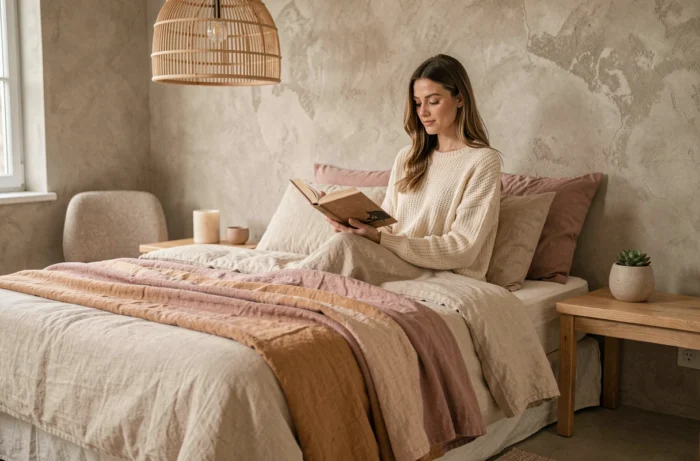
Warm sand is a neutral, but a lively one. Its role in the room is not to disappear: it serves as a binder between more assertive shades. Three combinations regularly appear in successful interiors, each producing a very different atmosphere.
- Warm sand and terracotta: the most coherent combination for a living room with Mediterranean accents. Terracotta is dosed in touches (cushions, vase, one wall in a niche) to avoid saturation. The sand occupies the large flat areas, walls, and ceiling.
- Warm sand and sage green: the duo creates a plant-like atmosphere without being overbearing. Sage green works particularly well in textiles (curtains, throw) against a sand wall backdrop. Avoid overly bright green, which clashes with the softness of the sand.
- Warm sand and off-white: the most understated option, suitable for small spaces. Off-white appears in woodwork or on the ceiling, with sand on the walls. The tonal difference is subtle but enough to give relief without visually weighing down the room.
It is noted that black also works, but in micro-doses: a wire light fixture, a thin frame, a furniture handle. Too much black disrupts the softness that sand brings.
Sand Accessories and Textiles: What Ages Well and What We Regret
Painting a wall is a commitment for a few years. Investing in accessories allows one to test the warm sand color without redecorating the entire room. In practice, some materials age significantly better than others.
Natural linen in sand tones retains its appearance over time. A washed linen curtain, a throw, cushion covers: these textiles develop a patina over washes and maintain their warm look. Feedback varies on this point regarding sand velvets, which tend to mark more and lose their luster after a few seasons.
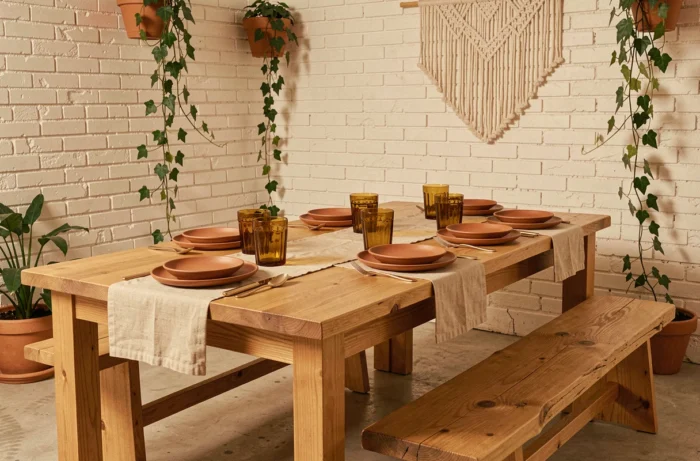
Accessories in matte ceramic or stoneware remain reliable choices to anchor the sand palette in a living room or dining room. A stoneware vase, a set of bowls, a candle holder: their raw texture naturally interacts with the hue.
What is often regretted: the light sand rug in a high-traffic area. Maintenance becomes a daily constraint. It is better to shift towards a deeper sand, almost caramel, for floors and heavily used seating.
Indoor Air Quality and Sand Paints: The Regulatory Point
Since January 1, 2023, decree no. 2022-1689 of December 27, 2022, sets a reference value of 100 µg/m³ for formaldehyde in indoor air for short-term exposure in France. This constraint pushes manufacturers to reformulate their ranges, including earthy and warm sand shades.
Specifically, for a kitchen or bathroom, two things should be checked on the can:
- The indoor air emissions label (A+ rating for the lowest VOCs)
- Resistance to humidity and washing, often noted in class on the technical sheet, because a sand paint resistant in a humid room must not sacrifice air quality
- The mention “no added formaldehyde” or explicit compliance with the 2023 regulatory threshold
Lime paints, often available in natural sand shades, offer an interesting alternative: they regulate humidity and their VOC emissions are naturally very low. The finish is more raw, more mineral, which suits wabi-sabi or contemporary country-style interiors.
Warm Sand in the Kitchen: Specific Precautions
The kitchen concentrates heat, steam, and grease splatters. A warm sand wall in matte paint behind the cooktop looks appealing in photos but is difficult to maintain. We prefer a satin or velvet finish in exposed areas, while keeping matte on walls far from the work surface.
Warm sand works remarkably well as a tiled backsplash (sand-toned zelliges, beige-gold cement tiles) where the material adds a relief that paint alone cannot offer.
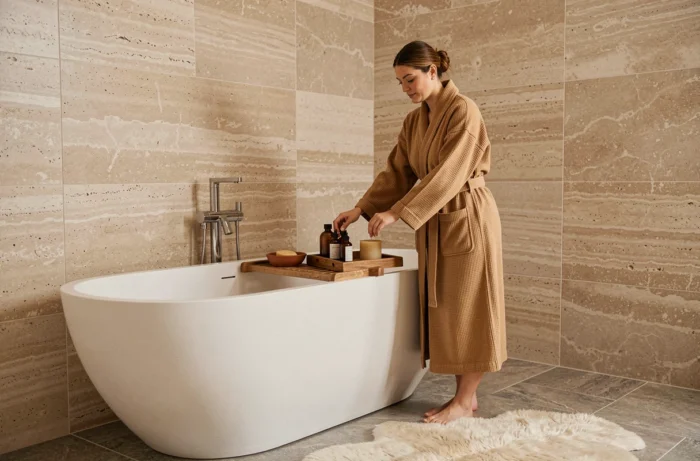
The trend of evolving neutrals, of which warm sand is the most accessible representative, is based on a simple principle: the neutral is no longer a passive background but an active participant in the ambiance. The choice of undertone, light orientation, and material quality matter as much as the hue itself. A well-applied sand, in the right room, with the right combinations, can easily last a decade without becoming tiresome.