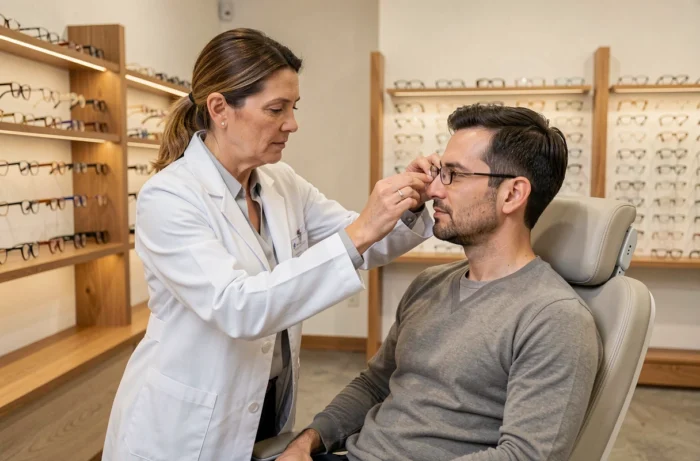
A local optician is not limited to selling frames. Behind the display of the neighborhood optical store lies a range of services related to visual health, the fitting of corrective lenses, and, recently, direct access to ophthalmological consultations. The scope of these services is evolving rapidly, driven by skill transfers and telemedicine technologies that are redefining the role of the optician.
Teleophthalmology in optical stores: a game-changing access to care
The most notable development in recent years is the installation of ophthalmological teleconsultation devices directly in stores. Several networks have equipped their shops with synchronous video consultation systems, allowing customers to consult an ophthalmologist live from the point of sale.
The Alain Afflelou Foundation and Medadom have reported over 100,000 visual screenings via teleconsultation conducted in about 250 equipped stores in France, with services covered under sector 1. Meanwhile, LyLeoo, a health tech specializing in tele-expertise, announced in August 2026 that it has doubled its network to reach 2,000 partner opticians across metropolitan and overseas territories, with a medical opinion returned in less than 24 hours.
This deployment transforms the optical store into a point of access for ophthalmological care, not just a place to buy glasses. For patients in areas where appointment wait times with ophthalmologists are increasing, this approach can significantly shorten the care pathway. However, the National Union of Ophthalmologists of France has raised concerns about potential abuses of optical tele-expertise and called for stricter regulation, indicating that the regulatory framework is still under construction.
To better understand the services available on Optisanté, it is important to distinguish between in-store advice, visual fitting, and these new telemedicine services.
Renewal of glasses prescriptions: what the optician can do without an ophthalmologist
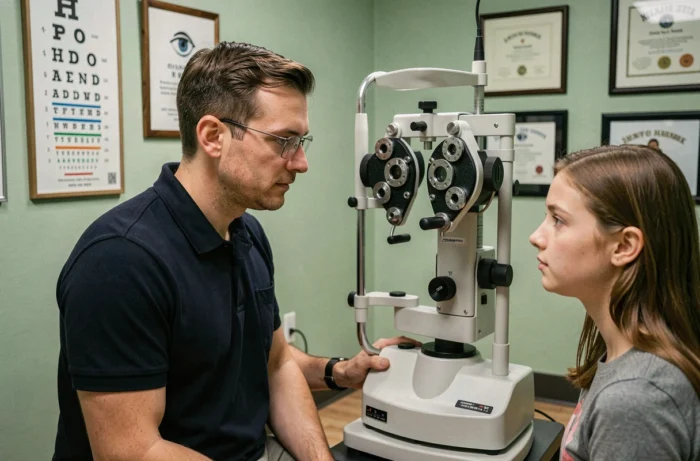
The legal framework now allows opticians to adapt a prescription during renewal, under certain conditions related to the validity of the prescription and the patient’s age. The validity period of a prescription for vision glasses is five years for adults aged 16 to 42, three years for those over 42, and one year for children under 16.
In practical terms, this means that a local optician can, during the validity of the prescription:
- Conduct a vision check in-store and modify the correction if the difference remains within the limits allowed by regulations
- Provide new optical equipment (corrective lenses, frame) without needing to go through an ophthalmology appointment again
- Adapt a prescription for contact lenses, again respecting the conditions set by law
This ability to adapt represents a real time-saving for glasses wearers. It does not replace a complete ophthalmological examination, but it streamlines the renewal process for common cases.
Advice on frames and lenses: the underestimated part of the service
The choice of a pair of glasses is not just an aesthetic question. The optician adjusts the frame to the shape of the face, measures the pupillary distance, determines the height of progressive lens fitting, and advises on surface treatments (anti-reflective, blue light filters, photochromic).
A poorly centered progressive lens by a few millimeters can cause headaches or discomfort when reading. The quality of centering and fitting determines visual comfort as much as the optical quality of the lens itself. This technical work, done face-to-face in the store, is difficult to replicate remotely or online.
The local optician also handles after-sales service: adjusting temples, replacing nose pads, tightening hinge screws, ultrasonic cleaning. These services, often free of charge, build customer loyalty but also represent a concrete follow-up of the equipment over time.
Contact lenses and low vision: specialized services in-store
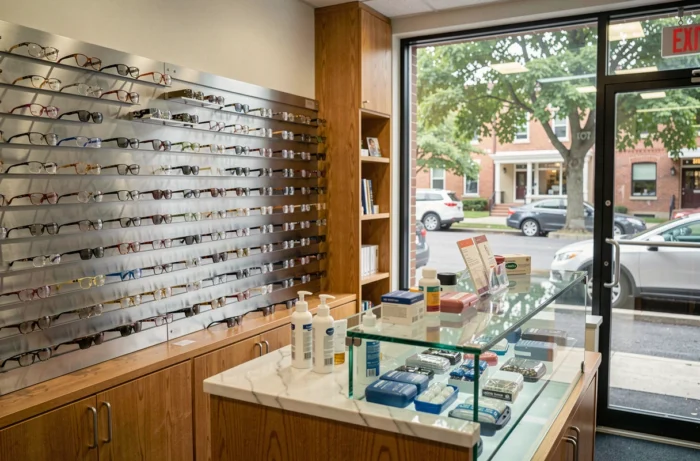
Not all opticians offer the same levels of specialization. Some stores have a dedicated space for contact lens fitting, with trials in a booth and personalized follow-up for wearers. Others focus on low vision, with specific equipment (electronic magnifiers, magnifying systems) intended for visually impaired individuals.
Contact lens services in-store generally include:
- An initial assessment to determine the type of lens suitable (soft, rigid, daily, monthly)
- Training sessions for putting on and taking off lenses, particularly useful for first-time wearers
- Regular follow-up with corneal tolerance checks
For low vision, the optician often works in conjunction with an ophthalmologist and an orthoptist. Field reports vary on the actual accessibility of these services: in large urban areas, several brands offer them, while in rural areas, the availability of contactology and low vision services remains uneven.
Third-party payment and reimbursement: the administrative role of the optician
Management of reimbursement with the mutual insurance
The local optician frequently manages third-party payments, which relieves the customer from having to advance costs covered by Social Security and supplementary health insurance. This often invisible administrative service involves an exchange of data between the store, Health Insurance, and the supplementary organization.
Standardized quotes and pricing transparency
Regulations require the provision of a standardized quote detailing separately the price of the frame, the price of the lenses, and the chosen options. This quote allows for comparing offers between several opticians before committing. The optician must also offer equipment in class A (100% Health basket) fully covered, with no out-of-pocket costs for patients with responsible supplementary insurance.
Thus, the neighborhood optical store encompasses a range of functions, from visual care to administrative management, which the rise of teleophthalmology further expands. Upcoming regulatory developments regarding skill transfers between ophthalmologists and opticians will determine how far this scope can extend.