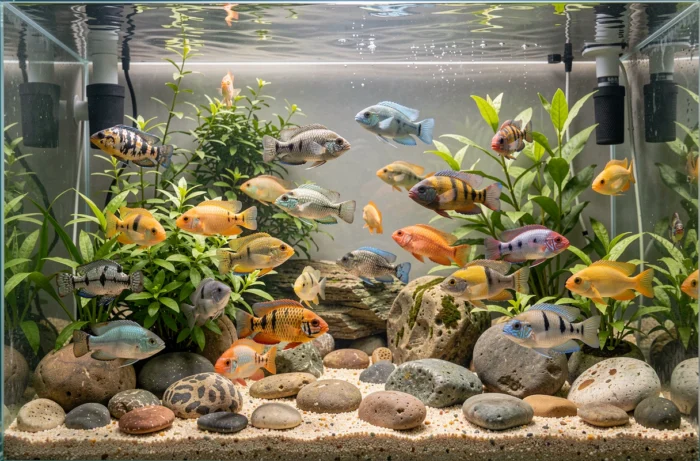
Cichlids are one of the most diverse families of freshwater fish in the world. They are primarily found in Africa and South America, in aquatic environments with very different parameters. Their complex social behavior and the care they provide for their young make them captivating residents for an aquarium.
Water hardness and geographical origin: the parameter that dictates everything
Have you ever noticed that two cichlids that look similar can require opposing maintenance conditions? The reason lies in their habitat of origin. African cichlids from Lake Malawi and Lake Tanganyika live in very hard and alkaline water. In contrast, South American species like the discus or the ramirezi need soft and slightly acidic water.
Mixing African and South American cichlids in the same tank ignores this fundamental constraint. One of the two groups will experience chronic stress that will shorten its lifespan and block any reproduction.
Before choosing your fish, test the hardness and pH of your tap water. If it is naturally hard, opt for cichlids from Lake Malawi or Tanganyika. If it is soft, South American species will adapt much better. The detailed sheets available on cichlidae.be allow you to check the required parameters for each species before purchase.

African or South American cichlids: choosing your aquarium biotope
Lake Malawi: colors and group dynamics
The mbunas of Lake Malawi are among the most colorful cichlids. They live in hierarchical groups in rocky areas. An aquarium for mbunas requires a generous volume (at least several hundred liters) and a decor made up of stacked stones forming numerous hiding places.
Slightly overstocking the tank dilutes aggression among territorial males. This counterintuitive technique is widely practiced by mbuna breeders to distribute interactions and limit the harassment of a single individual.
Tanganyika: specialized behaviors
Lake Tanganyika is home to species with more varied lifestyles. Some cichlids live in empty snail shells, while others form cooperative colonies where the young from previous broods help defend the territory. The brichardi (Neolamprologus brichardi) illustrates this collective guarding behavior.
The Tanganyika aquarium requires hard, alkaline, and very well-filtered water. Fine sand and empty shells form the basis of the decor for shell-dwelling species.
South America: discus, angelfish, and dwarfs
South American cichlids encompass very different species in size and temperament. The discus requires rigorous maintenance with warm and very soft water. The angelfish, more tolerant, is better suited for an aquarist who is starting with cichlids. Dwarf cichlids like the ramirezi fit well into planted community tanks of smaller volume.
Aquatic plants play a direct role here: they provide refuge for females and spawning support for several species. A South American tank without vegetation loses much of its biological interest.

Cichlid reproduction: mouthbrooding or substrate spawning
Reproduction is probably the most fascinating aspect of breeding cichlids. Two major strategies coexist within this family.
- Mouthbrooding: the female (sometimes the male) keeps the eggs and then the fry in her mouth for several weeks. Most cichlids from Lake Malawi do this. The female does not eat during this period, which requires her to be in good condition before breeding.
- Substrate spawning: the eggs are laid on a flat surface (stone, leaf, root) and both parents ventilate and defend them. This is the mode of reproduction for the angelfish, discus, and most South American dwarf cichlids.
- Cavity spawning: a variant of substrate spawning, the eggs are laid inside a cave or shell. The pelmato (Pelvicachromis pulcher) and the shell-dwellers of Tanganyika use this strategy. The defending parent can become very aggressive towards any intruder.
To observe reproduction, isolating the pair or trio in a dedicated tank yields much better results than in a community tank. A small volume of a few tens of liters, properly filtered, is sufficient for most dwarf species.
Treatments and health of cichlids: avoiding common mistakes
Cichlids are robust when the water parameters match their needs. Most diseases occur after stress related to poorly managed transport, a sudden water change, or poorly calculated overpopulation.
A recent trend observed among aquarists is to favor so-called natural products for treating tanks. Specialized retailers, on the other hand, sometimes use synthetic treatments as a preventive measure, not just curatively. This practice poses a risk of pathogen resistance to active substances.
The current recommendation is clear: reserve antibiotics for justified cases, with a specific substance, dose, and duration clearly defined. Using an antibacterial product as a simple “water corrector” exposes you to therapeutic failures when a real infection occurs.
Some preventive reflexes work better than any treatment:
- Quarantine any new fish for at least two weeks before introducing it into the main tank.
- Maintain a mature biological filtration and never clean all the filter media at the same time.
- Observe the behavior of the fish daily: a cichlid that isolates itself, loses its colors, or refuses food signals a problem before visible symptoms appear.

Regulations and purchase of wild cichlids
The trade of certain ornamental fish, including cichlids captured in the wild, is regulated by CITES and by European regulation (EC) No. 338/97. This regulation organizes its own annexes (A, B, C, D), distinct but inspired by the annexes of CITES. For species listed in Annex A, all commercial activity is in principle prohibited without an intra-community certificate.
In practice, the vast majority of cichlids sold in pet stores are farmed. Wild specimens, rarer and more expensive, mainly concern species from Lake Tanganyika or Malawi sought after by specialized aquarists. Checking the declared origin of the fish and requesting accompanying documents remains a good reflex, particularly for less common species.
A well-thought-out cichlid aquarium relies on a choice of compatible species, water parameters suited to their habitat of origin, and a measured approach to treatments. The rest, colors, displays, reproduction, comes naturally when these foundations are respected.