We’ve all seen that concrete cover or that plastic inspection chamber sitting in the middle of an otherwise immaculate lawn. Before placing anything on top of it, the first thing to understand is that the area above a septic tank is not just a piece of land. It is a technical zone, subject to constraints that dictate everything else: choice of covering, type of plants, permissible weight.
Loads and impermeable coverings: what the soil above a septic tank cannot support
A homeowner who wants to pour a concrete slab or lay asphalt over their sanitation system is heading straight for trouble. The surface covering the tank and the drainage field must remain permeable to air and water. Any impermeable covering prevents evapotranspiration and disrupts the biological functioning of the treatment system.
The rule also applies to loads. No vehicle traffic, no parking, no heavy storage (firewood, construction materials) in this area. Soil compaction compresses the drainage pipes and reduces the soil’s ability to filter wastewater.
Sometimes people think that a lightweight garden shed would be acceptable. Even a small structure on posts alters the load distribution and complicates access for maintenance. When considering what to do above a septic tank, the answer always starts with this accessibility constraint: the tank must be able to be emptied, inspected, and repaired without having to dismantle any installation.

Planting distance and choice of plants near the drainage field
Roots are the main enemy of sanitation pipes. Recent maintenance guides recommend maintaining a distance of at least three meters between any planting and the system (tank, drainage, filter). This setback applies to deep-rooted trees and shrubs, not ground covers.
Plants compatible with a sanitation system
Plants with shallow roots are the only ones that can tolerate direct proximity to the drainage field. Here are the categories that work without risk to the installation:
- Low ornamental grasses (fescues, sedges) whose roots remain in the first centimeters of soil and absorb excess moisture at the surface.
- Shallow-rooted ground cover perennials (creeping thyme, sedum, periwinkle), which cover the area without putting pressure on the pipes.
- Flowering meadows sown directly, composed of annual or biennial mixes that do not develop a woody root system.
Prohibit any tree or shrub with spreading roots (willow, poplar, maple, bamboo). Their roots seek moisture and infiltrate the pipe joints. A willow planted two meters from a drainage field can colonize the drains in just a few seasons.
Vegetable garden above the tank: why it is not recommended
Growing vegetables or fruits above a wastewater treatment system poses a health issue. The roots of vegetable crops come into contact with soil that receives partially treated effluents. Even though the actual risk depends on the type of installation and depth, no sanitation guide recommends growing food in this area.
Removable installation above a septic tank: deck on posts and removable solutions
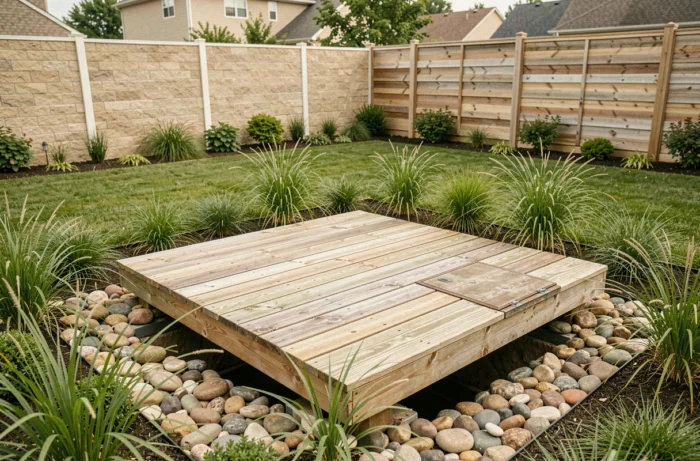
A deck on posts is the most coherent solution to visually dress the area without compromising the system. The boards (wood or composite) rest on adjustable posts placed directly on the ground, without foundation or sealing. The entire setup can be disassembled in a few hours for emptying or diagnosis.
Here are a few points to check before getting started:
- The posts must not rest directly on the tank cover. The structure should be offset so that the inspection chamber remains accessible, even if it means integrating a hatch into the decking.
- Ventilation under the decking must remain free. A space of at least a few centimeters between the ground and the boards allows for air circulation, which is essential for the proper functioning of the drainage.
- The total weight of the structure (posts, joists, boards) remains low compared to a poured slab, but it is still necessary to check that the underlying soil is not waterlogged in winter.
A well-designed deck on posts can be disassembled without leaving a trace, preserving access to the sanitation system and respecting the soil permeability constraint.

Concealing a septic tank cover without blocking access
The cover itself often concentrates all the aesthetic frustration. It can be hidden with movable elements: a hollow resin faux rock, a planter on wheels, or simply a large pot placed on top. The idea is that any camouflage element must be movable by one person in less than a minute.
Sealed solutions (masonry coping, glued stone) should be avoided. The technician who comes to empty the tank must have quick access to the cover. An installation that is too heavy or too complex to remove leads to increased intervention costs and, in some cases, outright refusal by the service provider.
For inspection chambers located in the lawn, a galvanized steel frame filled with synthetic or natural grass (on a removable base) allows the chamber to blend into the garden. Opinions vary on this point: some find that synthetic grass yellows differently than the rest of the lawn, creating a reverse effect.
Reserve drainage area: a space to protect from the garden’s design stage
There is much talk about the active drainage area, but less about the reserve area. This surface, planned from the installation of the sanitation system, is intended to accommodate a future drainage field if the first one reaches the end of its life. It must benefit from the same protections: no construction, no impermeable covering, no deep planting.
In practical terms, this means that a part of the garden that seems free is not. Before installing a pool, garage, or even a large shrub bed, check the sanitation plan submitted during installation. The reserve area is indicated on the non-collective sanitation plan, which can be consulted with the public sanitation service of the municipality.
Ignoring this area amounts to jeopardizing the possibility of renovating the treatment system without heavy work. When the main drainage field is clogged, the reserve area becomes the only option before a complete replacement of the installation, with the costs that this entails.