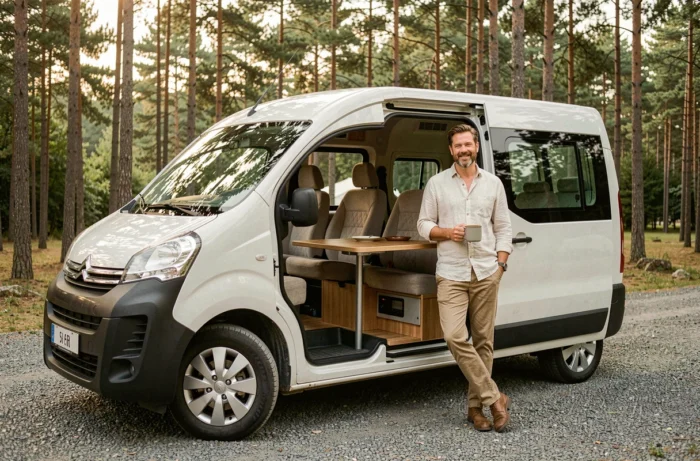
The Campster, a product of the Pössl-Citroën alliance based on the SpaceTourer, remains a compact van that divides opinions. Compact does not mean simple: the EMP2 platform shared with the entire Stellantis utility range imposes technical choices whose consequences are felt after several tens of thousands of kilometers. We review what owners are actually reporting, far from the manufacturer’s specifications.
Reliability of the BlueHDi engine and AdBlue system on the Campster
The BlueHDi 2.0 engine concentrates the majority of negative feedback on specialized forums. Recurring discussions focus on the untimely activation of the AdBlue warning light and pressure faults in the urea tank, without systematic support from the Citroën network.
This is not an isolated problem for the Campster. All Stellantis K0 vans share this architecture, and recent recalls confirm this. Stellantis has recalled nearly one million vehicles worldwide for a risk of malfunction, a campaign that directly affects the rolling bases used by Pössl.
We observe that owners who regularly drive on the highway report fewer AdBlue issues than those who make multiple short trips. The regeneration cycle of the particulate filter, which is demanding in terms of exhaust temperature, does not work well on journeys of just a few kilometers. For leisure van use with plenty of road travel, the engine meets its promises. For predominantly urban use, problems accumulate.
By compiling the user reviews on the Citroën Campster, a pattern emerges: the mechanics are not fragile in themselves, but the depollution system requires rigorous maintenance and an appropriate driving profile.
VASP homologation or CTTE registration: the ambiguity affecting insurance
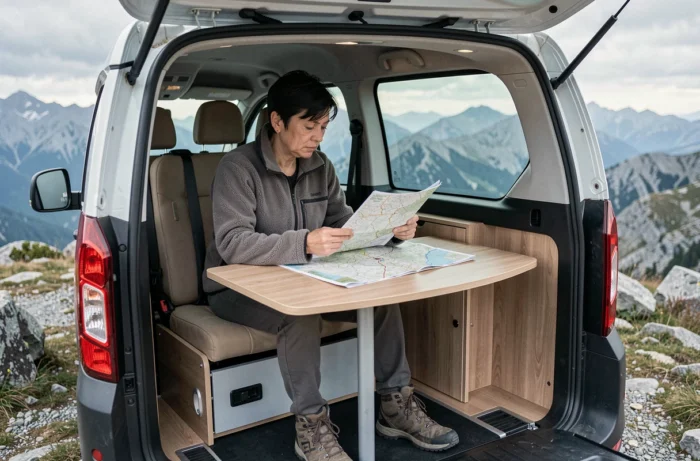
The removable layout of the Campster blurs the line between CTTE and VASP. This distinction is not merely administrative: it determines the applicable insurance contract, the guarantees in the event of a claim, and the coverage of the interior furnishings.
A fixed layout (integrated kitchen, non-removable bed, permanently connected water tank) logically requires a transition to VASP. The Campster, with its removable modules designed by Pössl, can theoretically remain in CTTE if no equipment is permanently attached to the chassis. In practice, tolerance varies according to prefectures and insurers.
- A Campster remaining in CTTE with installed kitchen and sleeping arrangements risks a denial of compensation in the event of a post-claim inspection, with the insurer potentially arguing a non-compliance of the registration document.
- The transition to VASP incurs an annual insurance cost increase and requires a specific technical inspection for leisure vehicles.
- Some owners declare their layout as “accessory equipment” to their insurer, a gray area that holds as long as no dispute arises.
We recommend clarifying this point before purchase, especially in the used market where the vehicle’s status may have changed hands without updating the registration document.
Campster in 2026 facing Stellantis recalls and the future of diesel
The question deserves to be asked directly: does the Campster remain relevant in light of the uncertainties surrounding the Stellantis platform and the regulatory evolution of diesel engines?
On the recall side, the increasing number of Stellantis campaigns on K0 vans undermines confidence. Active owners on the German Pössl Forum report issues with ambient lighting after the starter battery discharges, malfunctions of touch controls, and questions about the availability of spare wheels. These issues may seem minor when taken individually. However, when accumulated on a leisure vehicle used autonomously, they become serious irritants.
Regarding the engine, the BlueHDi diesel remains the only option on the Campster. No electric or hybrid variant is offered by Pössl on this base. Electric van initiatives exist, but they concern other manufacturers and other platforms. For a buyer considering keeping their vehicle for five years or more, the question of the residual value of a diesel in urban areas becomes concrete.
Real consumption and road range
Field reports indicate a consumption that fluctuates above the homologated values, which is not surprising for a vehicle of this size loaded with furnishings and water. The range heavily depends on the road profile and the load.
Users who go to the mountains with a full water tank and deployed sleeping arrangements report a noticeable increase in consumption compared to an empty SpaceTourer. The weight of the Pössl layout, even if removable, is felt on the passes.
Comfort of sleeping arrangements and actual livability of the Campster Pössl
Livability is the point that generates the most satisfaction in user feedback. The pop-up roof offers real sleeping space at height, and the modularity of the rear bench allows for a quick switch to night configuration.
Two nuances consistently arise:
- The width of the sleeping arrangements suits two average-sized adults but becomes restrictive beyond that. Taller owners report a lack of length on the lower bed.
- The acoustic and thermal insulation of the pop-up roof remains the structural weak point of the concept. Below five degrees, the soft roof allows significant cold to pass through, limiting the season of use without additional heating.
- The integrated water system works properly for occasional use, but its sizing remains modest for prolonged nomadic living.
In terms of storage, the Campster makes the most of every nook, a recognized Pössl signature. The retractable kitchen and side storage are praised for their engineering, even if the total volume remains that of a compact van and not a type H2 converted van.
The Campster remains relevant for regular leisure use, whether as a couple or with a reasonable-sized duo. For those considering a purchase in 2026, the priority is to check the vehicle’s recall history, resolve the VASP question before signing, and accept the limitations of a diesel engine without a short-term hybrid alternative. A well-documented used Campster remains a coherent van, provided that buyers enter the purchase with their eyes wide open.