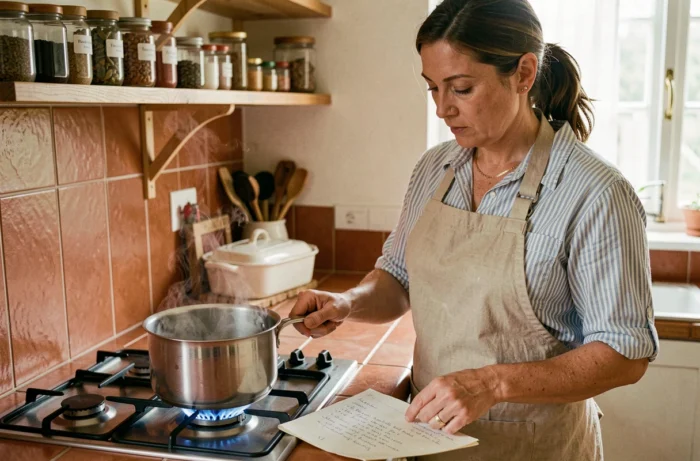
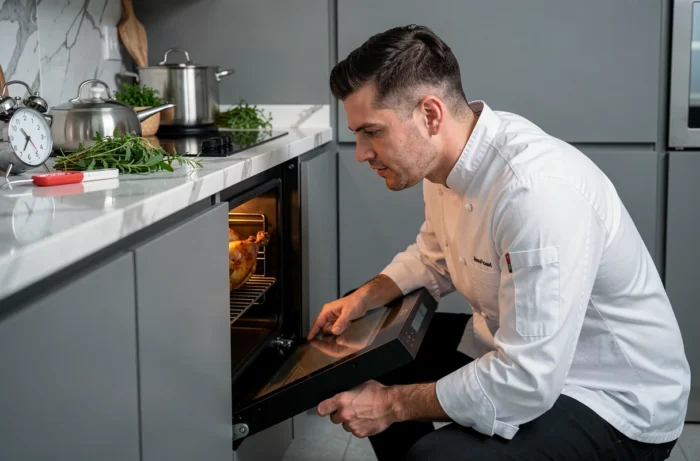
A chicken taken out of the oven too soon, soft pasta, vegetables still crunchy while the rest of the meal cools on the plate. Cooking times are problematic because they depend on variables that recipes do not always mention: thickness of the food, actual oven temperature, type of pan used. Understanding these variables allows you to correct the course before even starting the timer.
Core temperature: the benchmark that timers do not provide
Most recipes indicate a duration. Twenty minutes for a fillet, forty for a roast. The problem is that a two-centimeter thick fillet does not cook like a four-centimeter thick fillet, even in the same oven.
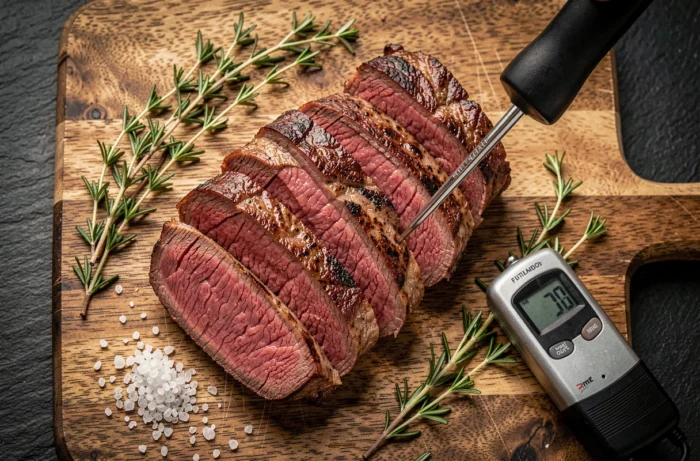
The reliable benchmark is the temperature measured at the center of the food. A probe kitchen thermometer costs a few euros and radically changes the accuracy. You insert the probe into the thickest part, and you read the result without opening the oven.
From a food safety perspective, the BfR (German Federal Institute for Risk Assessment) recommends that the core of poultry, pork, and minced meat reaches at least 70 °C for 2 minutes. This threshold significantly reduces the risk of salmonella. For collective catering, the standard rises to 72 °C for 2 minutes.
In other words, a chicken may look golden on the outside and remain undercooked on the inside. Color is not an indicator of cooking; temperature is. Checking the cooking times on Double Portion also allows you to cross-reference duration and target temperature for each type of food.
Cooking vegetables: adapting the method to the desired result
You may have noticed that steamed green beans and sautéed green beans do not have the same taste or texture, even with the same cooking time? The cooking method alters the result as much as the time itself.
Boiling salted water
This is the most common technique for green vegetables. The water must be boiling vigorously before plunging in the vegetables. If you put them in cold water, the slow temperature rise degrades the color and nutrients.
Salting the water before boiling barely speeds up the process, but the salt enhances the flavor of the vegetables by penetrating the fibers during cooking. A good benchmark: taste a piece rather than blindly following a timer.
Oven cooking for root vegetables
Carrots, parsnips, beets, potatoes: these dense vegetables require prolonged heat. Cut into even pieces, they cook uniformly. Pieces of different sizes in the same dish guarantee an uneven result, with burnt edges and a hard center.
A simple gesture improves the result: preheat the baking sheet with a drizzle of oil. The vegetables sear upon contact and caramelize instead of releasing their water.
Air fryer and traditional oven: converting cooking times
The air fryer has become established in many kitchens. Its operation relies on hot air circulation in a small space, which speeds up cooking compared to a conventional oven.
Recent conversion guides converge on one principle: reduce the temperature by 10 to 20 °C and the time by about 20% compared to a recipe designed for a traditional oven. Specifically, if a recipe indicates 200 °C for thirty minutes in the oven, the air fryer will require about 180 °C for twenty-four minutes.
This rule works well for small-sized foods (fries, nuggets, roasted vegetables). For larger pieces, the conversion becomes less predictable, as the restricted space of the air fryer limits air circulation around the food.
- Fries and small pieces: direct conversion with reduced temperature and duration, resulting in crispiness.
- Thick meats (whole chicken, roast): check the core temperature with a probe, as the surface browns quickly without the inside following.
- Baked goods and breads: the air fryer colors more on the surface, lower the temperature by 20 °C and monitor the last few minutes.
Cooking eggs: precise benchmarks for each texture
The egg is the food where the precision of cooking time is most noticeable. A one-minute difference visibly changes the texture of the yolk.
The starting point matters: plunging the eggs into already boiling water yields more consistent results than starting from cold, as the temperature rise varies depending on the amount of water and the heat intensity.
Here are the benchmarks for eggs taken out of the refrigerator and plunged into boiling water:
- Soft-boiled egg (runny yolk, set white): remove after six minutes, then immediately plunge into ice water to stop the cooking.
- Medium egg (creamy yolk, slightly set in the center): eight minutes.
- Hard-boiled egg (fully cooked yolk, no green ring): ten minutes maximum. Beyond that, the yolk takes on a greenish hue due to a chemical reaction between iron and sulfur.
The ice water bath after cooking is not a detail: it immediately stops the heat transfer. Without this step, the egg continues to cook by thermal inertia for several minutes.
Adapting cooking times to your equipment
A cast iron pot and a stainless steel saucepan do not conduct heat in the same way. Cast iron retains thermal energy and releases it slowly, which is suitable for stews but can overcook delicate food. Stainless steel heats up quickly and cools down rapidly as soon as the heat is reduced.
The type of burner also influences the result. An induction burner reacts within seconds to changes in settings. A ceramic glass plate retains heat after being turned off, which means that removing the pot from the heat a little before the theoretical end avoids overcooking.
The oven poses another trap: the displayed temperature and the actual temperature often differ by several degrees. An independent oven thermometer placed on the rack sometimes reveals surprising discrepancies. Correcting this offset just once improves all subsequent cooking.
Every kitchen is a different environment. The cooking times in recipes are starting points, not certainties. Tasting, poking, measuring the temperature: these actions take a few seconds and make the difference between a decent dish and a successful one.