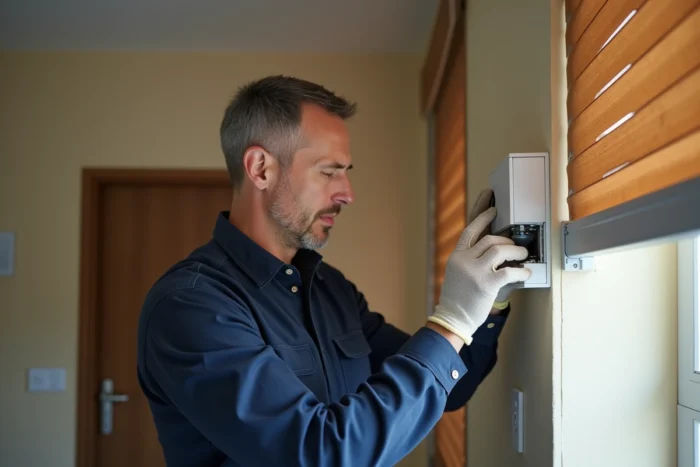
A tubular motor capacitor from Somfy that fails does not always produce a clear breakdown. The curtain may gradually slow down over several weeks, move in jerks, or stop halfway before restarting cold. Correctly identifying the capacitor failure before disassembling anything avoids replacing a still functional motor.
Validate the mechanical condition of the motor before touching the capacitor
A new capacitor will not fix a worn reducer. We recommend checking three mechanical points before any intervention on the capacitor, or risk wasting time and money on a motor at the end of its life.
- The motor must remain silent at rest and during rotation. A dry click or a dull rumble indicates play in the planetary reducer, not a capacitive fault.
- The brake (electromagnetic brake or mechanical brake depending on the model) must hold the curtain in position without slipping. A curtain that slowly descends on its own points to a failing brake rather than a defective capacitor.
- The motor shaft should show no perceptible radial play by hand. Mechanical play indicates wear on the bearings, and replacing the capacitor will not change that.
If the motor passes these three checks, the capacitor remains the main suspect. Otherwise, complete motor replacement is preferable. A clear and stable torque gain after changing the capacitor confirms that the intervention was relevant.
For those who wish to change the capacitor of a Somfy motor without going through a professional, the procedure remains accessible as long as this prior check is respected.
Measuring the capacitor with a multimeter: a reliable method on tubular motors
Visual diagnosis (swollen belly, electrolyte leakage) is not enough. A capacitor can be faulty without any external signs. The only reliable method remains the capacitance measurement with a multimeter in µF mode.
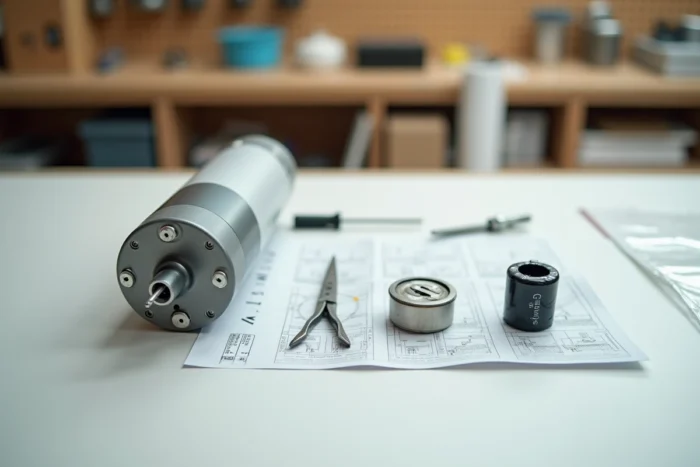
After cutting power at the circuit breaker and discharging the capacitor by short-circuiting its terminals with an insulated screwdriver, we measure the residual capacitance. A starting capacitor loses its function as soon as the measured value drops below 80% of the nominal value marked on the component’s body.
On Somfy tubular motors, the capacitor is accessible by removing the plastic cover on the motor head side. The wires are connected by 2.8 mm Faston terminals. Note their position before disconnecting anything.
Choosing the right capacitance in microfarads
The value in µF is printed on the body of the original capacitor. It varies according to the motor’s power and the torque required by the curtain. Installing a capacitor with a different capacitance alters the starting torque and can lead to erratic operation or even damage the motor windings.
The physical format is standardized on most Somfy tubular motors: cylindrical capacitor with 2.8 mm Faston terminals. The operating voltage must be equal to or greater than that of the original component. A capacitor costing around ten euros replaces a motor that costs twenty times more.
Reprogramming end limits after replacement on Somfy RTS or io motors
Replacement tutorials generally stop at mechanical reassembly. On a wired motor, this may be sufficient. On a radio RTS or io motor, replacing the capacitor often requires complete reprogramming.
The reason is rarely strictly technical. Before the clear breakdown, the weakened capacitor caused progressive torque losses. The motor sometimes compensated by drifting on its memorized end limit positions. Once the nominal torque is restored by the new capacitor, the recorded end limits no longer correspond to the physical reality of the curtain.
Reset procedure on RTS motor
The standard method involves a double power cut (cut for 2 seconds, power on for 8 seconds, cut for 2 seconds, power on). The motor then performs a brief back-and-forth movement confirming entry into programming mode. The remote control must then be re-associated via the PROG button and manually recalibrate the upper and lower end limits.
Somfy and Reparstores document these procedures in detail. Failing to follow them after changing the capacitor exposes you to a curtain that jams in the upper position or does not lower completely, which many users wrongly attribute to a faulty capacitor when the problem is software-related.
io homecontrol motors
On io motors, the reprogramming follows a similar logic but goes through the Situo io remote control or the TaHoma box if the curtain is associated with it. Deleting and then re-pairing the curtain in the TaHoma interface is sometimes necessary for the new end limits to be recognized by the home automation system.
Capacitor on Somfy awning motor: same principles, different constraints
The capacitor of an electric Somfy awning motor follows the same operational logic as that of a roller shutter. The difference lies in the torque required: an awning puts more strain on the motor during the lifting phase due to the weight and tension of the articulated arms.
The capacitor of an awning motor generally has a µF capacity greater than that of a roller shutter motor of the same tube diameter. We observe that capacitor failures on awnings occur more frequently at the beginning of the season, after several months of winter inactivity. The moisture accumulated in the box or under the fabric accelerates the degradation of the dielectric.
Removing the motor from an awning requires detaching the winding tube from the supports, a more cumbersome operation than on a standard roller shutter. Plan for a second person to hold the tube during removal.
Replacing the capacitor remains the most economical repair on a Somfy tubular motor with healthy mechanics. On a radio motor, neglecting the end limit reprogramming step turns a simple intervention into a series of false diagnoses. Check the mechanics, measure the capacitance, replace the component, then reprogram: these four steps, in this order, cover almost all cases encountered in the field.