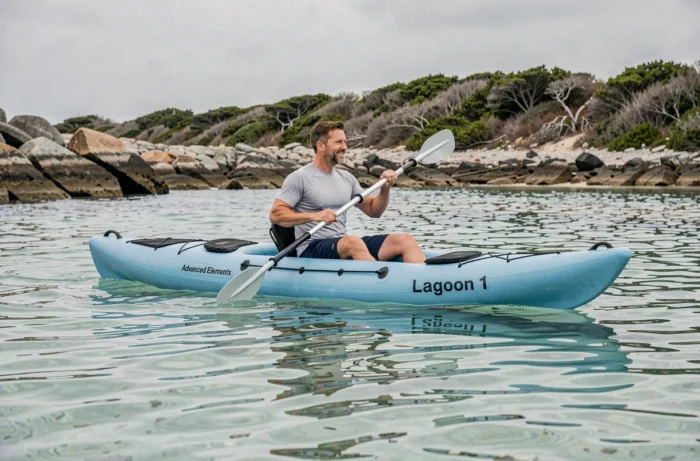
Transporting a rigid kayak on the roof of a car, finding a storage space, struggling to launch it alone: this is often what holds back occasional paddlers. The Advanced Elements Lagoon 1 inflatable kayak addresses this portability constraint without sacrificing on-water performance. We have compiled field feedback and technical data to help you determine if this model lives up to its reputation.
Stiffness and tracking of the Lagoon 1: what the inflatable really changes
Most entry-level inflatable kayaks deform under lateral current. The Lagoon 1 uses an aluminum frame integrated into the bow and stern. These rigid inserts give the hull a V shape that cuts through the water instead of bouncing off it.
On a calm lake, the difference compared to a standard inflatable is noticeable from the first paddle strokes: tracking remains stable without constant correction. In slow rivers, the performance holds up as long as you don’t try to tackle rapids.
You can find the Lagoon 1 kayak from Advanced Elements in several selections of durable kayaks for rivers and inland waters, confirming that it exceeds mere summer outing use.
Feedback varies on this point: some users find that the stiffness falls short compared to a true hard-shell kayak, especially in crosswinds. This is an inherent limitation of inflatables, even high-end ones.
Weight and compactness when folded: the real field argument
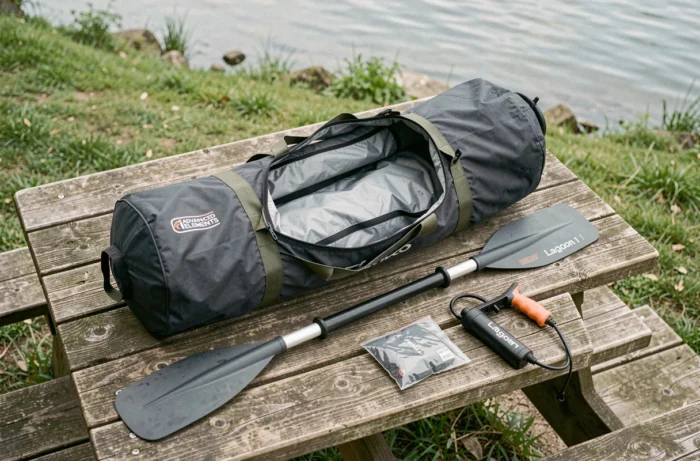
This is the most frequently mentioned advantage in reviews. The Lagoon 1 is among the lightest models in its category. Once deflated, it folds into a compact transport bag that fits in a small car trunk or the back of a closet.
For hikers or travelers, this format is a game changer. You can take it on a train, by plane (in the hold), or carry it on foot to a mountain lake without a dedicated vehicle. Inflating takes just a few minutes with a standard manual pump.
Comparison with a rigid kayak in real-life situations
A similarly sized rigid kayak easily weighs twice as much and requires roof bars, straps, and sometimes a launching cart. The Lagoon 1 eliminates all this logistics. The trade-off is slightly less pure performance in top speed and responsiveness in tight turns.
PVC construction and durability: what to expect after several seasons
The hull is made of reinforced multilayer PVC. This material holds up well against abrasion from protruding rocks and collisions with submerged branches. Welded seams limit the risk of gradual tearing that can be observed on less well-finished models.
Notably, some retailers now offer the Lagoon 1 with a three-year warranty, positioning it in a category of products designed to last beyond one or two seasons.
- The reinforced hull bottom withstands repeated contact with the bottoms of shallow rivers without showing signs of premature wear.
- The inflation valves are of the Twistlok type, a reliable standard found on professional models, which prevents slow leaks after a few months of use.
- The seat is adjustable and sufficiently padded for outings of two to three hours without lower back pain, even for average-sized individuals.
For taller individuals (over about 1.87 m), legroom becomes a bit tight. This is the main recurring complaint in user reviews.
Inflation, preparation, and launching: the concrete protocol
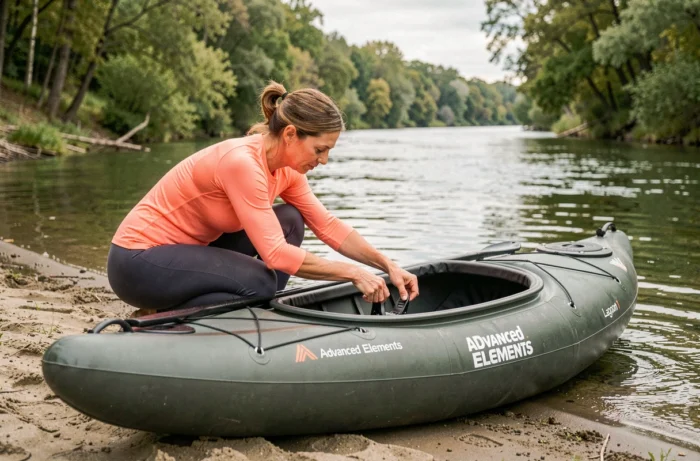
You unpack the bag, unfold the hull on a flat surface, and connect the pump. Inflation is done in three separate chambers, adding a layer of safety: if one chamber deflates, the other two maintain buoyancy.
Preparation steps before the first outing
- Inflate the three chambers to the recommended pressure (indicated on each valve) without exceeding it, especially in hot weather where air expands.
- Install the seat and adjust the back straps before launching, not after. On the water, it’s much more complicated.
- Check that the rear storage bag is securely attached: it also serves as a passive backrest and stabilizes the sitting position.
- Test the removable skeg on calm water before using it in a river. The skeg significantly improves tracking but can easily snag in shallow areas.
The total time from opening the bag to launching is around ten to fifteen minutes for someone familiar with the model. The first time, expect a bit longer.
Lagoon 1 inflatable kayak: for which type of paddler
This is not a sea kayak, nor a whitewater kayak. Its playground consists of lakes, canals, calm rivers, and sheltered estuaries. The Lagoon 1 is suitable for paddlers who want to go out regularly without logistical constraints.
Beginners will appreciate the initial stability, which forgives positioning errors. Intermediate paddlers will find a responsive boat for outings of a few hours, as long as they are not seeking athletic performance.
For tandem outings, Advanced Elements offers other two-person models. The Lagoon 1 remains strictly single-person, and loading too much gear onboard significantly reduces maneuverability.
The balance between navigational quality, material durability, and ease of transport places this inflatable kayak at the top of its range. If your priority is to paddle often without a garage or roof rack, this is a model to seriously consider.