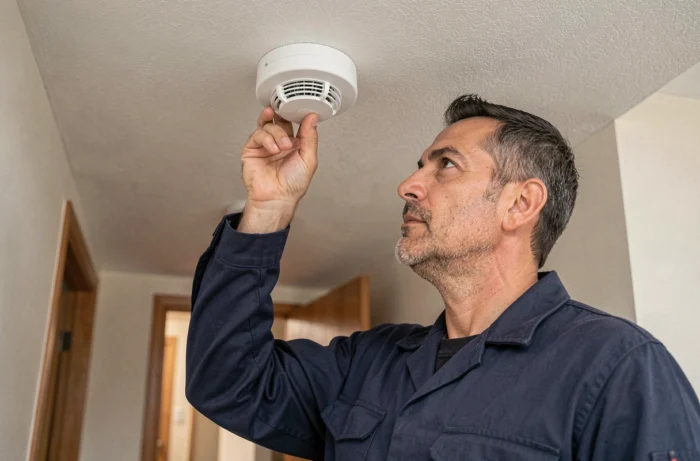
An autonomous smoke alarm (DAAF) that goes off in the middle of the night without any trace of fire presents a real problem: should you call the owner, intervene yourself, or contact emergency services? The answer depends on the cause of the alarm and the status of the occupant. The Construction and Housing Code divides responsibilities between the owner and the tenant, but this division does not cover all scenarios, especially when the alarm comes from a closed neighboring apartment.
Detection chamber and false alarms: understanding the DAAF mechanism
The DAAF operates thanks to an optical chamber that continuously analyzes airborne particles. When smoke particles enter this chamber, they deflect a light beam towards a sensor that triggers the sound signal.
The problem is that the chamber cannot distinguish fire smoke from other types of particles. Water vapor, accumulated dust, cooking residues, or even insects can cause exactly the same light deflection. A smoke detector that beeps for no reason almost always has an identifiable cause.
Clogging of the detection chamber remains the primary cause of false alarms. Regular cleaning with a vacuum cleaner with a fine nozzle is usually sufficient to eliminate unwanted triggers. Short and intermittent beeps, on the other hand, generally indicate low batteries, not the beginning of a fire.
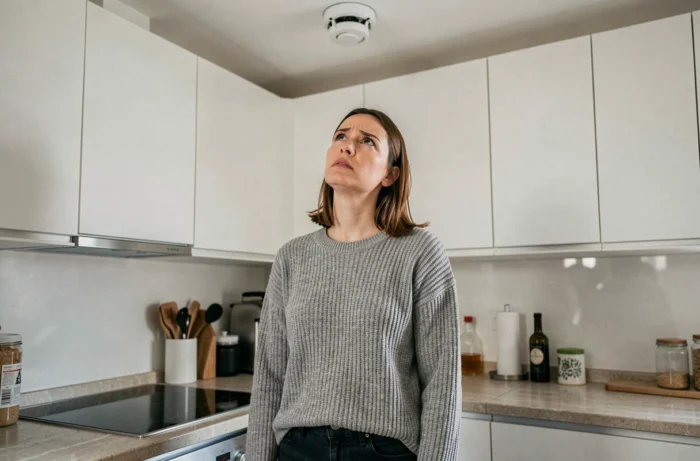
Smoke detector maintenance in rentals: who is responsible
Article L.142-1 of the Construction and Housing Code assigns the owner the obligation to install the DAAF and ensure its proper functioning during the entry inventory. The detector must bear the CE marking with reference to standard NF EN 14604.
Once the tenant is settled in, the division of responsibilities changes. The occupant is responsible for routine maintenance: replacing batteries, cleaning the detection chamber, and monthly testing of the verification button. This rule applies to unfurnished rental agreements.
Exceptions for furnished and seasonal rentals
In furnished rentals, seasonal rentals, hostels, or company housing, the maintenance of the detector remains the responsibility of the owner. The tenant is not required to intervene on the device in these specific cases. This distinction is often overlooked, even by landlords themselves.
The cost of the equipment (detector and replacement batteries for the initial installation) falls to the owner in all cases. A tenant in an unfurnished lease who replaces used batteries is performing routine maintenance at their own expense, but if the device itself is defective or expired, it is the landlord’s responsibility to provide a new DAAF.
Defective or expired device: when replacement is necessary
A DAAF has a limited lifespan. After several years of operation, the components of the optical chamber degrade, and the device may either fail to detect properly or trigger erratically. The manufacturing or expiration date is usually found on the back of the casing.
- If the detector triggers alerts despite careful cleaning and new batteries, the device is likely at the end of its life and should be completely replaced.
- If the test button produces no sound after replacing the batteries, the internal component is faulty.
- If the device does not bear the CE marking or the reference NF EN 14604, it is non-compliant and must be changed, regardless of its age.
In a rental property, the replacement of a defective or non-compliant detector is the responsibility of the owner. The tenant must report the malfunction in writing (letter or email with acknowledgment) to clearly establish the landlord’s responsibility.
Alarm in a closed neighboring apartment: the procedure to follow
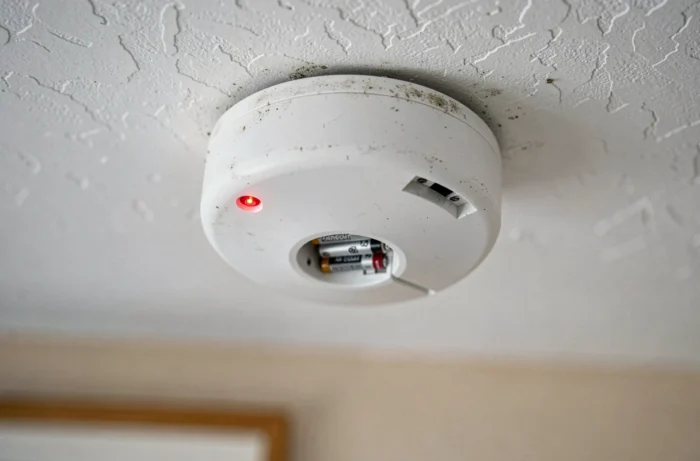
The most delicate situation arises when the sound signal comes from an apartment where the occupant is absent. A DAAF that continuously beeps in a closed apartment can indicate a real fire or simply a malfunction, and no one outside can determine which it is.
The first step is to notify the caretaker or the property manager. These contacts may have emergency contact details for the absent owner or tenant. If no contact allows for the apartment to be checked in a reasonable time, the firefighters remain the legitimate contact.
The firefighters can intervene even in the absence of visible smoke. Their training includes managing fire alarms without apparent fire. Waiting for the alarm to stop on its own, hoping for a simple battery issue, poses a real risk if a fire is indeed smoldering behind a closed door.
Responsibility of the neighbor who alerts the emergency services
A neighbor who calls the firefighters for a persistent alarm in a closed apartment does not incur financial liability, even if the intervention reveals a false alarm. The emergency services assess the situation and decide on the next steps. The cost of a firefighter intervention for suspected fire in a dwelling is not charged to the neighbor who raised the alarm.
Home insurance and repeated false alarms
Home insurance covers damages caused by a fire, but the issue of defective detectors touches on another aspect of the contract. Some policies mention the obligation for the insured to have a functioning DAAF.
- An absent or deliberately disabled detector can be invoked by the insurer in the event of a claim to limit compensation.
- Repeated unaddressed false alarms can constitute a nuisance if they regularly disturb the condominium.
- The tenant who neglects routine maintenance and suffers a loss exposes themselves to a discussion regarding coverage by their insurance.
Maintaining the DAAF in working order protects against both fire and insurance disputes. Written notification to the owner in case of a defective device serves as useful evidence in the event of subsequent disputes.
The reflex when faced with a detector that beeps for no apparent reason remains the same in all cases: check for smoke, silence the alarm if possible, and then identify the cause. The battery, dust, and being too close to a steam source cover the vast majority of situations. Everything else falls either to the landlord or to the emergency services.