
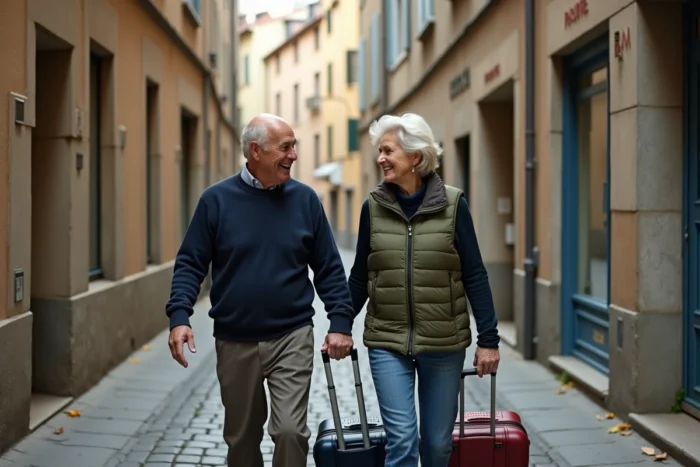
A French retired couple arriving in Tirana in May with tickets costing less than 100 euros one way: this scenario, once rare three years ago, is becoming common. Traveling after 60 no longer raises the question of “why” but rather “where to go without getting tired, without breaking the bank, and without encountering the same crowds as in Lisbon in August.”
We take stock of the game-changing destinations and the concrete choices to make before packing your suitcase.
Senior Destinations in Europe: Alternatives to Saturated Portugal
Portugal remains pleasant, but its prices have caught up with those in France in tourist areas. Since 2025, several European regions are attracting senior travelers with a cost of living 40 to 50% lower than in France, direct flight connections, and mid-season temperatures between 20 and 25 °C.
The Albanian Riviera is among those “refuge” destinations identified by the specialized press in 2026. Marie France describes Albania as the “new paradise for seniors” for budget-friendly vacations. The Asturias and Cantabria regions in northern Spain offer a preserved coastline, far from the Costa del Sol. Varna, Bulgaria, combines beach, thermal baths, and accessible medical facilities.
To enjoy these destinations without unpleasant surprises, we recommend traveling in May, June, or September. Summer remains too hot around the Mediterranean and brings back the crowds. The Seniors du Monde community allows you to share concrete experiences before choosing your travel period.
Travel and Health Insurance Abroad After 60
This aspect is often underestimated. The European Health Insurance Card (EHIC) covers care in the EU, but only based on the rates of the visited country. In Albania or Turkey (outside the EU), it is of no use.
Taking out a repatriation insurance specifically for seniors is not superfluous. Standard contracts from bank cards often cap coverage at 60 or 65 years, or even exclude certain pre-existing conditions. Before leaving, check three specific points:
- The reimbursement cap for medical expenses abroad (some contracts limit it to a few thousand euros, insufficient for hospitalization)
- The coverage for medical repatriation, including for countries outside the Schengen area
- Exclusions related to chronic illnesses or ongoing treatments, common in entry-level plans
Feedback varies on this point, but several comparison sites like Reassurez-moi offer specific grids for expatriate seniors or those on extended stays. Reading the general conditions remains the only way to know what is actually covered.
Solo Travel After 60: Safety and Practical Logistics
Traveling alone after retirement can be daunting, especially the first time. The main barrier is not danger, but organization. Preparing a senior solo trip is mainly about anticipating transfers and downtime.
Avoid long layovers with tight connections. A direct flight, even slightly more expensive, reduces fatigue and the risk of lost luggage. For accommodation, apartments with kitchens allow you to manage your eating schedule without relying on restaurant hours.
Staying Connected and Securing Your Travels
Two simple reflexes make a difference. First, share your itinerary with a loved one via a location app (Google Maps, WhatsApp live location). Then, keep a digital copy of your passport and medical prescription in a secure cloud or in your email.
For destinations outside Europe, register on Ariane, the service from the Ministry of Foreign Affairs that provides real-time security alerts and facilitates contact in case of a crisis.

Panoramic Train Journeys: The Pace Suited for Seniors
Train travel is making a comeback among European retirees, and not just for ecological reasons. Traveling by train eliminates the fatigue of the airport, security checks, boarding lines, and baggage restrictions.
Several scenic routes are particularly suited for a slow stay:
- The coastal train Bergen-Bodø in Norway, which runs along the fjords for several hundred kilometers with possible stops along the way
- The Transcantábrico in Spain, a tourist train that crosses Asturias and Cantabria with onboard accommodation
- The TER lines in southern France (Marseille-Nice, Toulouse-Latour-de-Carol), accessible with a simple SNCF Senior Advantage card
These journeys allow you to break up the trip, get off when fatigue sets in, and resume the next day. It’s the opposite of a fixed itinerary cruise: you maintain control over your pace.
Rail Discounts for Those Over 60
The SNCF Senior Advantage card provides access to discounts on TGV and Intercités trains. In Europe, the Interrail pass offers a senior option with reduced fares for travelers over 60. Booking outside school holidays remains the most effective lever for obtaining low prices, regardless of the medium used.
The choice between plane and train depends less on budget than on tolerance for fatigue. On a Paris-Barcelona or Lyon-Milan route, the train takes only slightly longer door to door once airport times are accounted for, with significantly less physical stress. For more distant destinations, combining a short direct flight with a local train itinerary remains the best compromise.