A dyslexic student receives their assessment at the same time as others, on the same sheet, with the same font. They know the answer, but by the time they decipher the instructions, half of the allotted time has passed. This gap between actual competence and measured performance summarizes the challenge of inclusivity in my class in 2026.
Support systems exist (PAP, PPS, PPRE), legislation regulates them, and digital platforms offer adapted features. The problem rarely lies in the lack of tools. It plays out in daily implementation, class by class, teacher by teacher.
Adapting an assessment for a dyslexic student without lowering expectations
You may have noticed that a dyslexic student can shine orally yet submit a nearly unreadable paper? This is not a paradox. It is a disorder that affects the input or output channel of information, not the understanding itself.
Adapting an assessment does not mean simplifying it. It means modifying the format without changing the expected level. Specifically, a teacher can rephrase instructions into shorter sentences, increase the font size, or allow extra time. These adjustments are included in the PAP when it is properly drafted.
The difficulty lies in the fact that many teachers discover a student’s PAP at the beginning of the year, without training on what each adjustment entails in practice. A document stating “read instructions aloud” assumes that someone is available to do so during the test. When the class has thirty students and only one adult, this adjustment becomes theoretical.
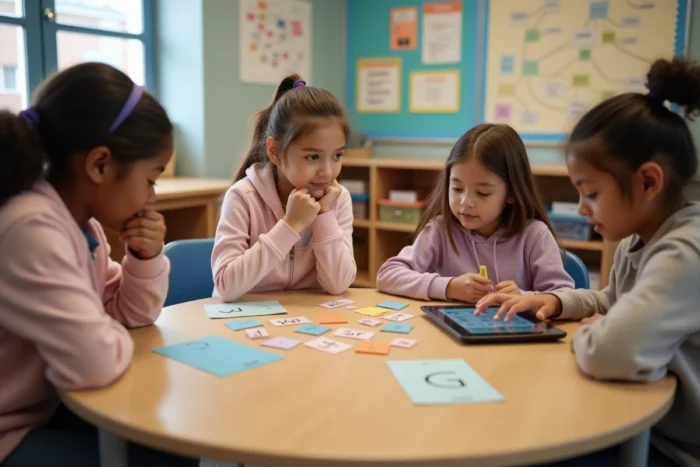
To better understand how inclusivity works in my class 2026, we need to look at what digital platforms actually allow: integrated text-to-speech, automatic typographic adaptation, rephrasing of instructions. These functions exist, but their activation depends on the settings made by the teacher for each student profile.
A concrete suggestion: prepare two versions of the same test. The adapted version keeps the same questions and grading scale. Only the layout (larger font, increased spacing, one instruction per page) and the time allocated change. The objective remains the same, but the path to achieve it differs.
PPRE, PAP, or PPS: choosing the right educational support system
Three acronyms, three very different logics. Confusing them delays support, sometimes by several months.
- PPRE (personalized educational success program) is aimed at any student experiencing temporary difficulties. It does not require any medical diagnosis. The educational team implements it quickly, often within a few weeks, to target a specific skill (reading, calculation, methodology).
- PAP (personalized support plan) concerns learning disorders recognized by a doctor. It provides sustainable educational adjustments without going through the MDPH. It is the most common system for dys students.
- PPS (personalized schooling project) comes into play when the disability situation requires resources that the school cannot provide alone: AESH, adapted educational materials, referral to a specialized class. It must go through the MDPH.
A common pitfall: a teacher implementing a PPRE for a severe dyslexic student because it is quicker. The PPRE does not provide extra time for exams, nor formal adaptation of materials. A poor system delays access to truly useful adjustments.
The PAI (individualized welcome project) is sometimes confused with the three previous ones. It exclusively concerns medical conditions (allergy, diabetes, epilepsy) and does not address learning disorders.
Support centers for schooling: a first-level resource still little known
Support centers for schooling (PAS) represent a recent link in the inclusive school system. They are presented as a first-level response to families, and their generalization is expected by 2027.
Their role: to offer educational adjustments, adapted materials, or the intervention of professionals from the National Education and the medico-social sector, without waiting for the often lengthy delay of an MDPH notification.
For a teacher identifying a student in difficulty, the PAS provides a concrete contact. Rather than navigating alone between the school doctor, the RASED psychologist, and the family, they can reach out to this center for a quick situational diagnosis and operational recommendations.

The current limitation lies in deployment. Not all institutions yet have access to a functional PAS. The scaling up depends on the academies, and teachers in rural areas or in small institutions are often the last to be served.
Daily dys support: what works in the classroom
The main principles of adaptation are documented. What is lacking are simple pedagogical gestures, those that require neither budget nor long training.
- Placing the dys student in the front row reduces visual distractions and facilitates listening to oral instructions. This is a reflex that many teachers already apply, but it disappears as soon as a seating plan changes.
- Giving the instruction both orally AND in writing at the same time. A dyslexic student captures information better when both channels function in parallel.
- Limiting copying from the board. A dysorthographic student who spends twenty minutes copying a lesson has learned nothing during that time. Providing a printed or digital support frees cognitive load for understanding.
- Allowing compensatory digital tools (spell checker, text-to-speech software) without reserving them solely for evaluation moments.
These adjustments do not require a complete rethink. They assume anticipation during lesson preparation, not a pedagogical overhaul.
The decisive factor remains communication between the teacher and the family. A PAP reviewed together at the beginning of the year, with concrete objectives and a timeline for checkpoints, avoids misunderstandings in March. School inclusivity in 2026 is not played out in official texts; it is built through these regular exchanges, class by class.