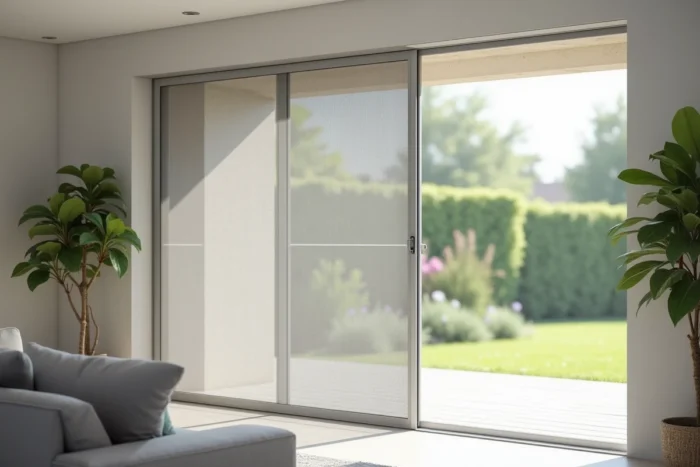
A sliding door of 300 x 220 cm is a wide and tall passage that we open several times a day in summer. Finding a roll-up mosquito net suitable for this size presents a concrete problem: most vertical roll-up models cap their width well below 3,000 mm. Thus, one finds themselves having to choose between the type of mechanism, number of panels, and mounting constraints before even discussing fabric or color.
Maximum width of a roll-up panel: the blocking point on a 300 cm opening
Many technical sheets for vertical roll-up mosquito nets limit the width to about 1,800 mm for a height that can reach 2,600 mm. Faced with an opening of 3,000 mm, a single vertical roll-up panel is not enough. We exceed the standard size, and the fabric risks buckling or coming out of the tracks if we force the dimensions.
Two solutions then present themselves. The first: opt for a lateral roll-up system with two panels that meet in the center, each covering about 1,500 mm. The second: switch to a pleated or sliding mosquito net, designed from the outset for large widths.
When specifically looking for a roll-up mosquito net for sliding door 300 x 220, checking the maximum width per panel on the manufacturer’s technical sheet remains the first reflex. A model advertised as compatible with 3,000 mm in one piece deserves a close look at the guiding system and the rigidity of the box.

Roll-up, pleated, or sliding mosquito net: which mechanism for frequent passage
Professionals increasingly distinguish “frequent passage” solutions from “ventilation without passage” solutions. A sliding door, by definition, serves as access to the garden or terrace. It is opened and closed dozens of times a day in the hot season.
The lateral roll-up is suitable if the passage remains moderate (a few back and forths per hour). The fabric retracts into an aluminum box fixed on one side, and the vertical tracks maintain the guidance. For intensive use, feedback varies on this point, but the spring mechanism may wear out faster than a pleated system without a spring.
Pleated and sliding: alternatives for heavily used openings
The pleated mosquito net folds like an accordion into a side profile. No spring, no fabric that slaps back. For a 300 cm opening, it is available in a two-panel version with a central magnetic closure.
The sliding version operates on a bottom rail and a top rail. It slides like a sliding door. This is the most robust solution for very frequent passage, but it requires a floor rail that may obstruct the threshold.
- Lateral roll-up: compact at rest, suitable for moderate passages, discreet aluminum box on one side
- Pleated two panels: no spring, magnetic closure, good stability on large widths
- Sliding on rails: the strongest for intensive use, but requires a compatible threshold
Installation constraints on a sliding door with a roller shutter
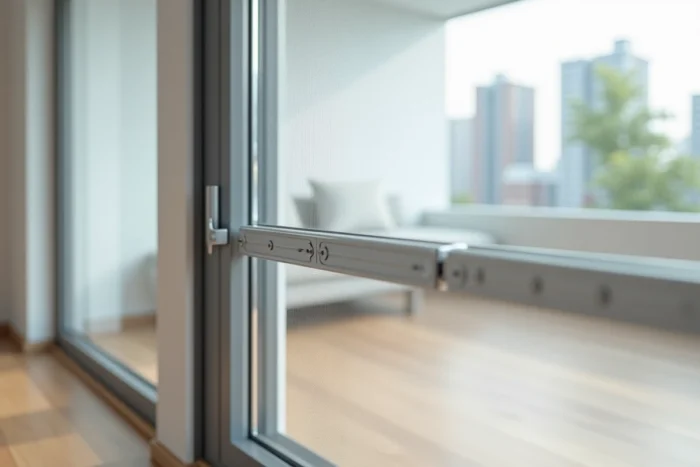
It is often forgotten at the time of ordering: the presence of a roller shutter reduces the available mounting space. Between the shutter box, the frame of the sliding door, and the wall, there may only be 25 to 30 mm of play left. This is too little to accommodate the box of a standard roll-up mosquito net, which generally measures 40 to 50 mm in depth.
In this situation, one resorts to space-saving solutions: magnetic mosquito net (removable frame without drilling), or pleated with a thin profile. Before ordering, accurately measuring the clearance between the roller shutter and the frame of the sliding door avoids an unpleasant surprise upon delivery.
Mounting in the frame or surface-mounted: consequences on dimensions
Mounting in the frame (inside the opening) reduces the usable dimensions of the mosquito net by a few centimeters on each side. On a 300 cm sliding door, one easily loses 4 to 6 cm in total width, which can be problematic if the fabric is already at the limit of the model’s capacity.
Surface mounting (on the wall, around the opening) offers more flexibility on dimensions and simplifies the alignment of the tracks. However, it requires drilling into the masonry or wood of the frame.
Fabric and colors: criteria that change daily comfort
The choice of fabric directly influences visibility to the outside and air circulation. A fiberglass fabric with a fine mesh blocks the smallest insects (gnats, tiger mosquitoes) while allowing maximum light to pass through. The black color offers the best visual transparency: paradoxically, one can see better through a black fabric than through gray or white fabric.
For the frame and tracks, aluminum remains the reference material. It does not deform under heat, resists humidity, and comes in several colors (white, anthracite gray, brown) to match the frame of the sliding door.
- Black fiberglass fabric: best visibility, good airflow, decent UV resistance
- Polyester fabric: more economical, but tends to sag over time on large widths
- Micro-perforated anti-pollen fabric: tighter mesh, slightly reduces ventilation but filters fine particles
On a 300 x 220 sliding door, favoring a rigid fabric that does not buckle in the wind makes the difference between equipment that is actually used and an accessory that ends up being left open.
Custom sizing is almost always necessary for these dimensions. Standard mosquito nets rarely cover a width of 3,000 mm, and adjusting a model that is too small with DIY compromises insect tightness. Going through a manufacturer that offers custom cutting with tracks adapted to a height of 2,200 mm ensures correct guidance of the fabric throughout its travel.