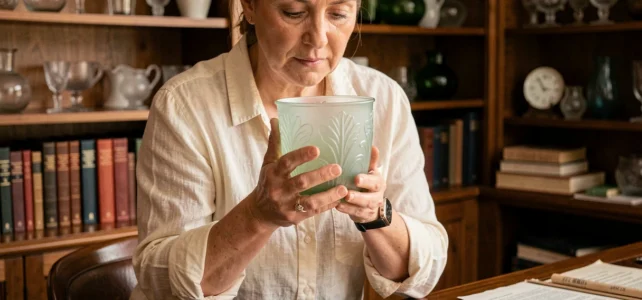
The Portieux catalog remains the only reliable tool for attributing a piece to a specific series, distinguishing an in-house production from a post-fusion Vallerysthal model, or dating a pressed decor. We find that the majority of identification errors in the market stem from a lack of knowledge about catalog editions and their respective documentary gaps.
Original and reissued Portieux catalogs: documentary distinction criteria
A modern reissue of a Portieux catalog never reproduces the entirety of the source document. The period commercial mentions, internal model references, and wholesale sales conditions systematically disappear from recent reproductions. It is precisely this commercial material that allows for the dating and attribution of a piece with certainty.
We recommend prioritizing the verification of these elements in any digitized version. A catalog that contains only visual plates without original pricing or numbering is a partial reissue, useful for form but insufficient for authentication.
Collectors consulting the Portieux glass catalog on Direct Habitat gain access to a comparison of available sources that clarifies these distinctions between original documents and reproductions.
The 1914 catalog, known as “Vallerysthal and Portieux United,” is the most comprehensive reference for the pivotal period of fusion. The Departmental Archives of Marne hold copies covering the editions of 1908, 1911, and 1914. These three vintages allow for tracking the evolution of ranges just before World War I, a period when production reached its peak diversity.
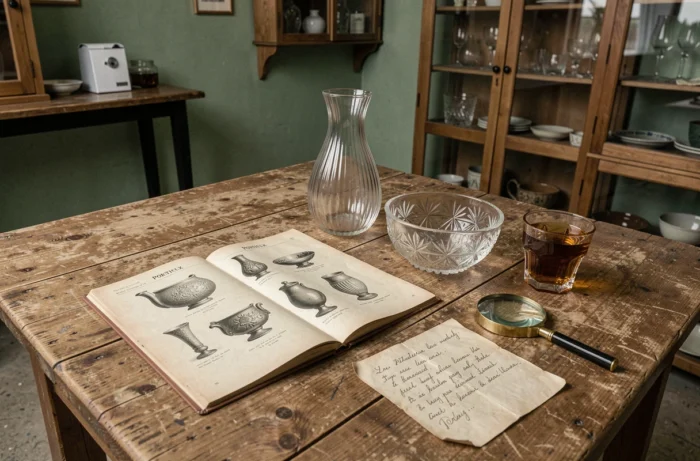
Identifying a Portieux glass: reading plates and attribution pitfalls
The same mold may have been used at Portieux and Vallerysthal after the merger. This is the most underestimated technical point by casual collectors. Two visually identical pieces may appear in two distinct catalogs under different references, simply because production was transferred from one site to another.
Reading a catalog plate requires cross-referencing three pieces of information:
- The internal model number, often engraved or stamped on older pieces but absent from later productions
- The shape of the pressed or cut decor, which varies between series even when the general contour remains identical
- The mention of the original glassworks on the plate (Portieux only, Vallerysthal only, or “United Glassworks”), which indicates the manufacturing period
Without this cross-referencing, attributing a sugar bowl or vase to Portieux rather than Vallerysthal is a matter of conjecture. Specialized blogs reproduce isolated plates without always specifying to which edition of the catalog they belong, leading to cascading errors on collector forums.
The case of wine glasses and table services
Wine glasses represent the most common category in the secondary market, but also the most difficult to authenticate without a catalog. Portieux produced dozens of models with very similar profiles. Only the serial number on the plate allows for distinguishing a “Champagne” model from a “Burgundy” model when the difference in contour does not exceed a few millimeters.
We observe that specialized antique dealers, such as those listed in Colmar, systematically rely on the plates for their attributions. This rigor remains rare among generalist resellers.

Digitization and Portieux archives: the real state of available online sources
Portieux catalogs are not centralized on any single portal. Documentation is spread across departmental archives, enthusiast blogs, Pinterest boards, and heritage sites, each with a very variable level of coverage and reliability.
The Departmental Archives of Marne offer the most reliable copies in terms of documentation. They reference the editions of the United Glassworks of Vallerysthal and Portieux for 1908, 1911, and 1914, with notices that allow for cross-referencing inventories and digitized plates.
Specialized blogs in glass art provide commented plates by experienced collectors, but their coverage remains partial and updates irregular. Pinterest aggregates photos of pages from old catalogs without indexing by model, making navigation laborious for targeted searches.
Cross-referencing between inventories and digital catalogs
French heritage collections now integrate a logic of cross-referencing between descriptive inventories and digitized catalogs. An inventory notice can refer to a catalog plate that is consultable online, and vice versa. For research on Portieux, this means that a collector should no longer limit themselves to isolated scans but also query heritage inventory databases.
Active digitization continues: private archives continue to index and share Portieux catalogs, notably the 1914 edition, well beyond the usual commercial circuits.
Portieux glassworks and late productions: the documentary gray area
Productions after World War II constitute the main blind spot of available catalogs. Digitized editions predominantly cover the period from the late 19th century to the 1910s. The series produced in the second half of the 20th century, before the final closure, remain largely absent from accessible online sources.
This gap has a direct consequence on the market: late pieces are often undervalued due to lack of documentation. A collector who cannot link an object to a catalog plate hesitates to invest, even when the quality of craftsmanship is present.
- Catalogs covering the years 1930 to 1960 circulate almost exclusively within private collector circles
- Colored opaline glass productions (type “milk glass”) from the late period do not appear in any public digitized database to date
- Post-merger models with Vallerysthal rarely bear a distinct mark, complicating attribution further
For collectors specialized in these periods, relying on private archive circles and exchanges among enthusiasts remains the only way to access usable documentation. The rarity of these catalogs makes them collectible items in their own right, with their documentary value far exceeding their acquisition price.