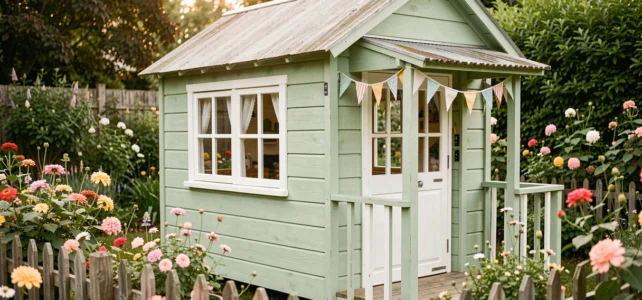
A playhouse delivered raw or simply assembled in the garden often remains underutilized. Children rush to it in the first few days, but then the enthusiasm wanes. The problem does not lie with the cabin itself, but with what is put inside and how the space is organized. Designing a playhouse for children means transforming a few square meters into a place that the child can claim as their own for a long time.
Floor and fall zones: the foundation before any decoration
Before thinking about curtains or garlands, look at the floor. Inside the playhouse, a soft covering (interlocking foam tiles or washable outdoor rugs) protects knees and insulates from the cold. Outside, the landing area at the foot of a potential slide or mezzanine deserves a cushioning layer: wood chips, sand, or thick synthetic grass.
Since December 2024, the Regulation (EU) 2023/988 on the general safety of products requires manufacturers and sellers to better document the risks associated with children’s play equipment, including those intended for private gardens. Usage warnings and incident tracking directly concern playhouses equipped with elevated platforms or fall zones.
To explore playhouse models and find a starting point, several specialized catalogs are available online, including https://lamaisonnettedebarbichounette.fr/, which brings together various configurations suitable for family gardens.
On the urban planning regulation side, a cabin of less than five square meters of footprint and less than twelve meters in height generally does not require any formalities. Between five and twenty square meters, a prior declaration is required. Also, check your municipality’s PLU, which may impose additional setback or height constraints.
Interior design: creating distinct activity corners
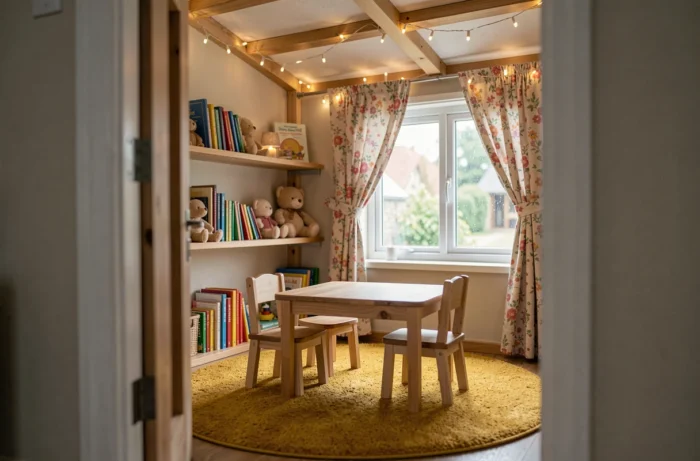
Have you noticed that a child rarely plays the same way for an entire afternoon? They move from drawing to playing house, then to reading. Dividing the playhouse into two or three micro-zones allows for this natural rhythm without the space becoming chaotic.
Reading and resting corner
A thick floor cushion, a small low shelf fixed to the wall, and a few books are enough. The shelf should be at child height so they can help themselves. Prefer screw fixings rather than glued ones: the vibrations from play can detach adhesives within weeks.
Imitation and symbolic play corner
A mini wooden kitchen, a fake tool workbench, or a merchant’s counter transforms the cabin into a symbolic play area. This type of play develops cognitive functions and the ability to negotiate with other children.
Rather than accumulating accessories, focus on one theme at a time. A single, well-equipped theme stimulates more than a collection of mismatched objects. You can rotate themes every two or three months to renew interest.
Integrated storage
Storage is not a logistical detail; it is a play element. Open bins labeled with pictograms (rather than text) allow the child to tidy up independently from the age of three. Fix hooks at the entrance to hang costumes or aprons.
- Open stackable bins with visual labels, placed on the floor or on a low shelf, so the child can identify each category of toys without help
- Child-height wall hooks (about one meter off the ground) to hang costumes, bags, or play accessories
- Waterproof fabric basket near the entrance for shoes or sand toys that should not enter the cabin
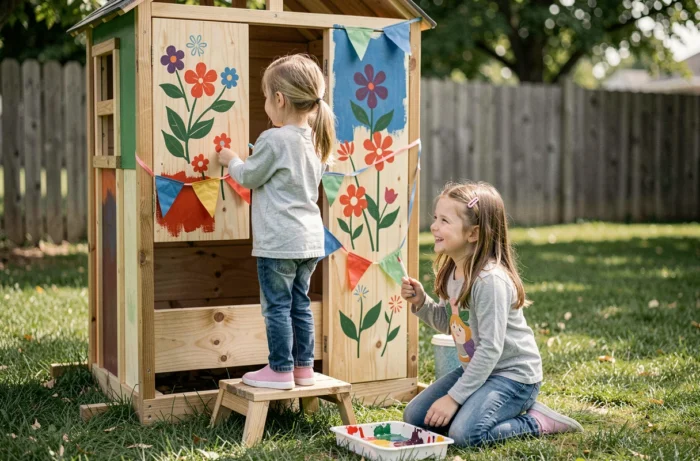
Exterior decoration of the playhouse: personalize without weakening
The temptation to paint the cabin in bright colors is great from the first weekend. Before pulling out the brushes, check that the chosen paint is toy or food contact certified (EN 71-3 standard). Classic outdoor wood paints contain biocides or solvents that young children should not put in their mouths.
A few simple additions can radically change the appearance of the cabin without weakening it:
- Planters fixed under the windows, planted with hardy herbs (thyme, rosemary), that the child can water and smell
- House number and small wooden mailbox, which turn the playhouse into a real address and provide an excuse to write messages
- Miniature doormat at the entrance, which establishes a transition ritual between the garden and the inside of the cabin
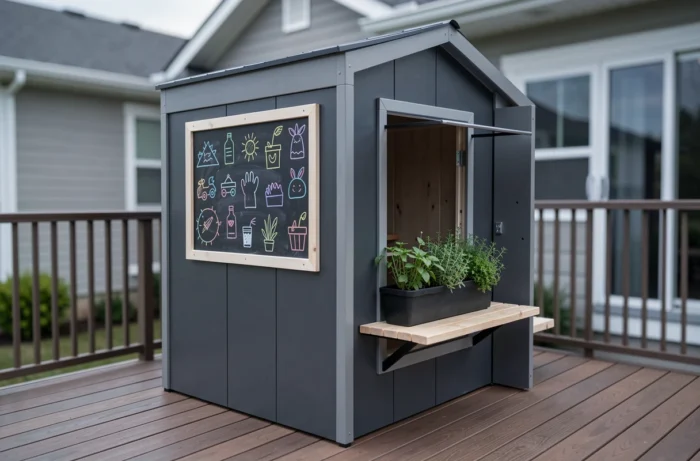
- Chalkboard paint on a designated exterior panel, for drawing with chalk without damaging the entire structure
Avoid electric garlands not intended for outdoor use. If you want lighting, low-voltage solar LED garlands are a more suitable choice. No electrical cable should cross an area of play accessible to children.
Adapting the playhouse to age and seasons
A cabin designed for a three-year-old will not work as is for a seven-year-old. Why this discrepancy? Because motor and social needs evolve quickly.
Between three and five years, the child needs to manipulate, transfer, and imitate. The furniture must be stable, and the objects large and easy to grasp. From the age of six, play becomes more narrative and collaborative. The cabin can accommodate a whiteboard, maps, or a small desk for writing or drawing.
Planning for modular fixings from the start (shelf rails, pre-drilled holes at different heights) avoids having to re-screw everything every year. In winter, a thick curtain at the entrance and an additional rug extend usage by a few weeks. In summer, a stretched shade cloth above the roof limits overheating inside.
Designing a playhouse is not just a shopping list. It is a project that benefits from being regularly rethought, depending on what the child actually does in the cabin. Observing their play for a week before making any changes remains the most reliable method to invest in the right place.